What to Do After a Reactive Dog Meltdown
After a full barking, lunging, screaming meltdown, the useful question is not 'how do I correct that?' It is: how do I help the nervous system come back down and prevent tomorrow from becoming worse?
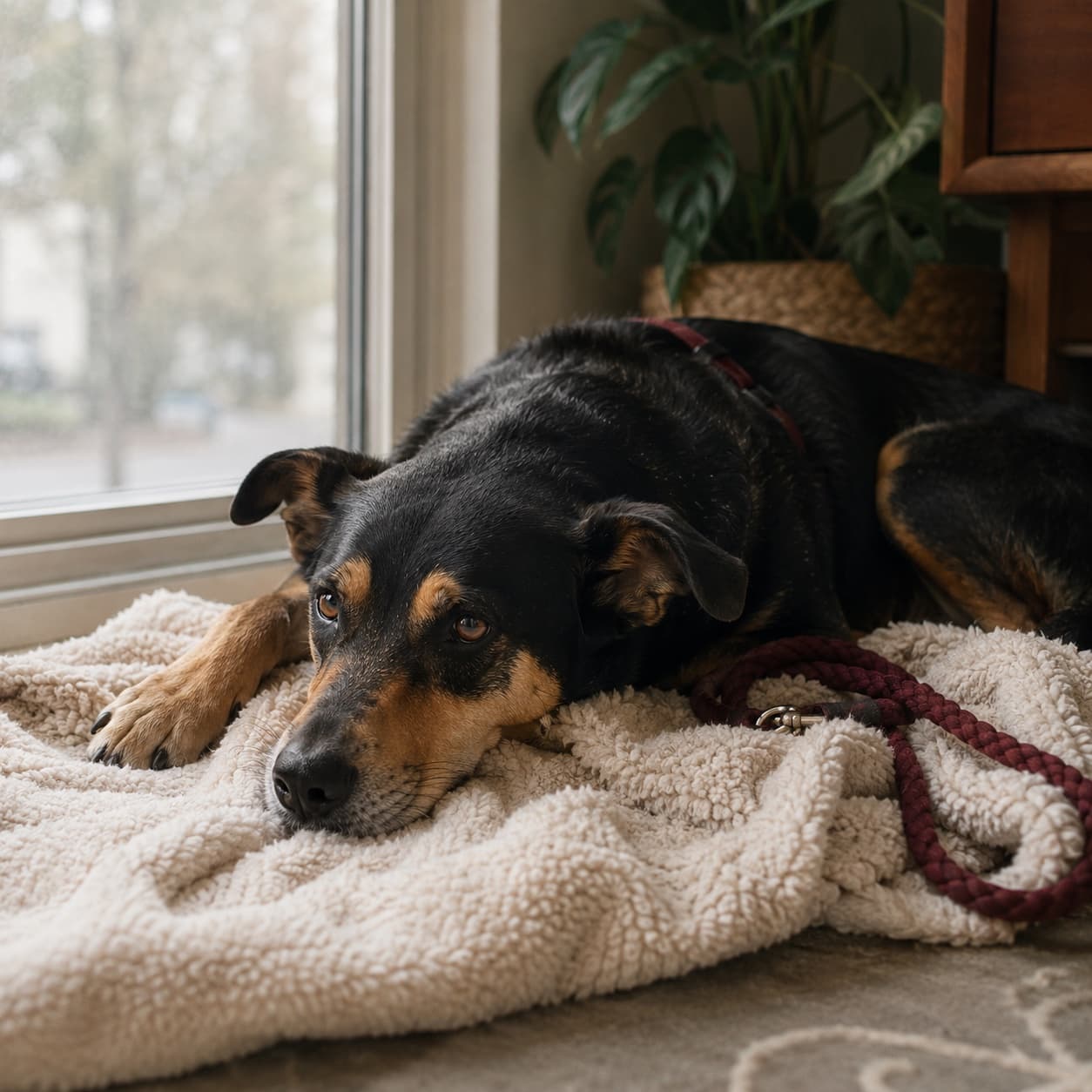
What to do after reactive dog meltdown is one of the most urgent questions owners ask because the event is loud, public, and physical. Your dog barks, lunges, screams, or thrashes. You get them away. Then the adrenaline drops and the guilt arrives: did I ruin the training? Should I correct it? Should I walk again tomorrow?
The answer is calmer than the moment feels. You do not need a dramatic punishment or a dramatic reset. You need recovery, a better next setup, and a way to learn from what happened.
Reactive dog meltdown recovery timeline
The bigger the reaction, the easier the next 24-72 hours should be.
| Window | Main job | Good choices |
|---|---|---|
| Same day | Get the body down | Quiet room, sniffing, water, food puzzle, short potty-only outings. |
| Next day | Prevent another rehearsal | Easy route, more distance, no training setups, watch sleep and appetite. |
| 48-72 hours | Test baseline gently | Return to light LAT only if your dog is eating, sniffing, and recovering normally. |
First: leave cleanly
Once your dog is over threshold, the training window has closed. The first job is not to explain, correct, or ask for obedience. It is to create distance safely. Move behind a car, turn down a driveway, cross the street, or leave the area.
If your dog cannot hear you, that is not stubbornness. It is arousal. The thinking brain is not available. This is the same mechanism behind trigger stacking: once the nervous system is overloaded, the next useful move is recovery.
Do this after the meltdown
- Create distance without arguing with the dog.
- Keep your voice low and your leash handling boring.
- Go home or switch to a very easy sniff-only route.
- Write down what happened before memory turns it into a blur.
- Make the next walk easier, not more ambitious.
What to log
The log is not for blaming yourself. It is for spotting the setup. Most meltdowns look random until you write down the previous 48 hours: poor sleep, visitors, daycare, construction, a vet visit, a hard walk, or three small trigger events that all seemed manageable at the time.
| Log field | Example | Why it matters |
|---|---|---|
| Trigger | Large dog at 20 feet, child running, bike behind us. | Shows which trigger type needs easier setups. |
| Distance | Across street, same sidewalk, behind fence. | Threshold distance is one of the best progress metrics. |
| Recovery | Ate after 30 seconds, scanned for 10 minutes, slept all afternoon. | Recovery tells you how hard the event was on the dog. |
| Prior 48 hours | Groomer yesterday, poor sleep, two surprise dogs this morning. | This is where trigger stacking usually shows up. |
When to get help
Get professional help if the dog redirects onto you, bites, cannot recover, has escalating intensity, or seems painful or medically off. Reactivity is common and workable, but safety cases need hands-on support. A veterinary behaviorist or qualified behavior consultant can help decide whether medication, pain screening, or a more controlled setup belongs in the plan.
Rough walk check-in
Three quick questions after a hard walk. No email required — use this to decide whether tomorrow should be easier, cautious, or a recovery day.
Take pressure off the next 48 hours
One or two stressors may still be elevated. Skip training setups tomorrow; prioritize sleep, sniffing, and an easy route.
Log walks and get a planEvidence basis
This article is grounded in humane, reward-based behavior guidance and PawZen's science page.
Quick answers
Should I correct my dog after a reactive meltdown?
No. After the event, correction does not teach the dog what to do next time. Focus on safety, distance, decompression, and changing the next setup.
How long should my dog rest after a meltdown?
Many dogs need a quieter 24-72 hour window after a full over-threshold event. The exact timing depends on recovery, sleep, appetite, and how quickly the dog returns to baseline.
Should I skip walks after a meltdown?
Skip hard walks, not all movement. Use potty breaks, sniffing, food puzzles, quiet routes, or private spaces so the dog can decompress without rehearsing another reaction.
Can my dog be worse the day after a meltdown?
Yes. Some dogs have a lower threshold the next day because stress, poor sleep, and repeated trigger exposure stack. Make the next 24 hours easier and judge progress by recovery, not by one hard event.
Related reading
- Karen Overall Relaxation Protocol GuideReactive dogs do not only need trigger work. They also need a nervous system that can settle. The relaxation protocol gives calm behavior a repeatable structure.
- What is trigger stacking? Why your dog's meltdown wasn't random.A trigger isn't the cause. The cause was yesterday — and the day before that. Understanding this one mechanism changes everything about how you read your dog's walks.
- How long to desensitize a reactive dog? A realistic timeline.Every reactive dog owner wants a timeline. The real one has four phases, a handful of variables, and one rule most programs get wrong: consistency beats intensity every time.
Log tonight’s rough walk and get tomorrow’s plan adjusted
Use PawZen to capture what happened, plan distance and recovery, and avoid repeating the same setup tomorrow.
Optional: notify me when the 30-Day Calm Walk Reset program opens (not required to use the free app).