What is LAT training? The most underused tool for reactive dogs.
LAT is deceptively simple: mark the instant your dog sees a trigger, then pay. Done right, it rewires the emotional response from 'threat' to 'predictor of good things.' Done wrong, it's just an expensive way to feed your dog in front of scary stuff.
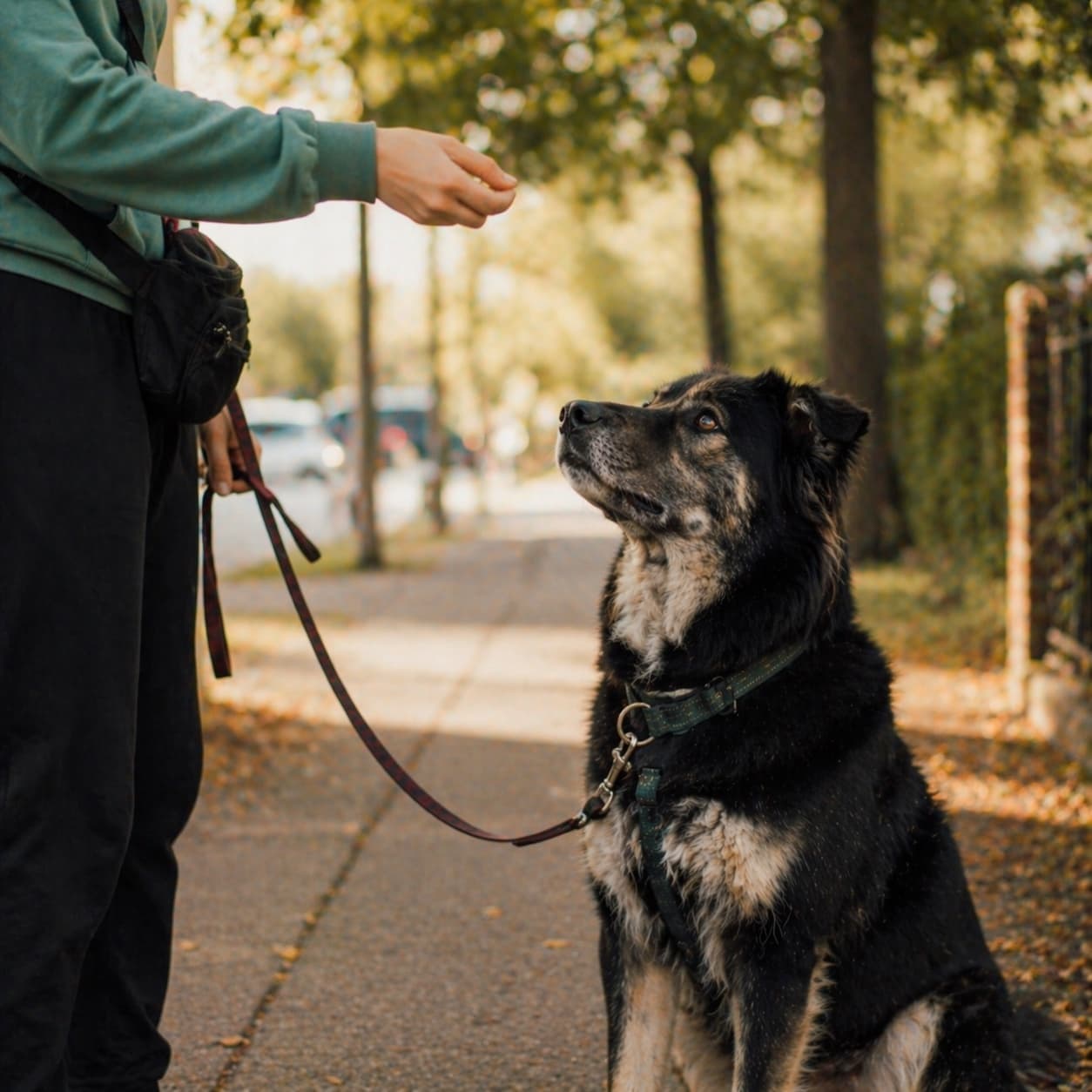
If you only ever learn one reactive-dog protocol, let it be this one. LAT — Look At That — is the most reliable, most portable, and most forgiving intervention for reactivity we know of. It was introduced in Leslie McDevitt's 2007 book Control Unleashed, and in the 18 years since it has become the quiet backbone of most modern reactive-dog training.
It's also the intervention owners are least often taught, because it sounds almost too simple to work.
The protocol, in one paragraph
At a distance where your dog can see a trigger (a dog, a stranger, a bike) and still respond to you: the instant your dog notices the trigger, you mark it with a clicker or a marker word ("yes!"), and then feed a high-value treat. You are paying your dog for seeingthe trigger, not for doing anything about it. Over many repetitions, your dog's emotional response to the trigger flips: "Dog — ugh" becomes "Dog — oh! Good thing!"
That's it. That's the whole protocol. The rest of this post is about doing it right.
Why it works
LAT is a specific implementation of classical counter-conditioning— the Pavlov-style pairing of a neutral (or negative) stimulus with something positive until the emotional response flips. You're not teaching a behavior. You're changing how your dog feels about a thing.
What makes LAT cleaner than generic counter-conditioning is the marker. The mark (click or "yes!") happens at the exact millisecond the dog's eyes land on the trigger — which tells the brain, very precisely, what is being paid for. Without the marker, your treat-after-dog-appears is slightly fuzzy; your dog's brain has to figure out which moment in the sequence the treat is about. The marker removes the ambiguity.
How to do it right
Start at a distance your dog can handle
This is where most LAT attempts fail. If your dog is already over threshold when it sees the trigger, LAT won't work — the thinking brain is offline, and you're just feeding a panicking dog. (Often that's trigger stackingfrom earlier in the day, not "stubbornness.") You need sub-threshold distance: the distance at which your dog can see the trigger and still eat. If the only place you can find that distance today is an empty parking lot with a friend walking their dog 100 feet away, that's where you start. Not closer.
Mark the instant of seeing
Your dog turns its head. Its eyes land. Mark, right then. Not after. Not "when my dog looks back at me." The mark is for the seeing, because that's the moment we're pairing with good feelings. If you wait until your dog disengages, you're training disengagement — which isn't bad, but it's a different protocol (engage-disengage) and works more slowly.
Use a treat worth the effort
Classical counter-conditioning only works if the positive is meaningful to the dog. For many reactive dogs on-leash, kibble isn't going to cut it. Cooked chicken, real cheese, freeze-dried liver — pick the thing your dog would sell you out for. Save it only for reactivity work.
Keep sessions short
5–10 minutes of LAT is plenty. Reactivity work is cognitively exhausting for the dog. Short sessions, high frequency, end on a win. A 5-minute session every day for 3 weeks outperforms a 30-minute session once a week by a huge margin.
Don't chase
If the trigger moves closer and crosses your dog's threshold — leave. Don't try to salvage. Don't try to "push through just this once." You have succeeded if you exit before the over-threshold reaction. You have failed if you stayed and paid through a meltdown, because now you've just conditioned your dog to treat-while-panicking, which is worse than doing nothing.
Common mistakes
| Mistake | Why it fails | Cleaner replacement |
|---|---|---|
| Luring first | The dog learns to follow food, not to feel differently about the trigger. | Let the dog notice, then mark and feed. |
| Marking too late | If the bark has started, you are no longer pairing a calm notice with food. | Increase distance and mark the first glance. |
| Running long sessions | Fatigue and trigger stacking make clean reps disappear. | Stop after 5-10 minutes or after a small win. |
| Starting too close | Above threshold, food becomes noise and learning gets messy. | Choose boring distance over impressive distance. |
Luring instead of marking
Some owners wave the treat in front of the dog's nose to distract from the trigger. This isn't LAT. This is bribery, and it doesn't produce emotional change — it just temporarily overrides the reaction. The moment the treat isn't there, the reaction returns, often louder.
Marking the bark instead of the sight
If your dog is already barking when you mark, you are paying the bark. Don't. Exit, regroup, find a bigger distance, and try again. The mark is for sub-threshold noticing.
Only doing it with dogs
LAT works for any trigger: dogs, bikes, children, skateboards, strangers with hats. If your dog stacks multiple triggers (most do — see what trigger stacking is), work them separately. You can't CC your dog to "everything." You CC to specific things, one or two at a time.
Expecting a week to be enough
LAT is a conditioning protocol, not a command. Conditioning takes repetition across days and weeks. Most owners see first visible results (the "check-in" happening spontaneously) in 2–4 weeks of daily 5-minute sessions. Stable change takes months — we unpack timelines in how long desensitization takes. But it's extremely boring-looking work that produces permanent emotional change — we'll take that trade every time.
When to use it (and when not to)
LAT is the right tool for:
- Fear-based reactivity to specific visual triggers (other dogs, strangers, bikes, etc.)
- Dogs who can see a trigger and stay below threshold at some distance
- Building a reliable "check-in" default under pressure
LAT is not the right tool for:
- Dogs currently over threshold (use distance first, LAT later)
- Resource guarding (different protocol set)
- Handler-directed aggression (this is a behavior-consultant case, not a DIY one)
- Auditory-only reactivity where there's nothing to "look at" (use sound-based CC/DS instead)
Why this is PawZen's default protocol
When we build daily plans, LAT is usually the first tool in the drawer. It's portable — works on any walk. It's forgiving — a handful of imperfect reps a day still moves the needle. It produces emotional change, not just suppression. And it's grounded in the most studied learning mechanism we have (classical conditioning), not in trainer charisma.
If you're brand-new to reactivity training and you want one thing to start with tonight, it's this. Treats in your pocket. A distance your dog can handle. Mark-and-feed every time your dog looks at the trigger. If walks feel chaotic first, use the 7-day starter plan or read why dogs bark at every dog on walks — same nervous system, different symptom. Two weeks later, write us and tell us what changed.
Evidence basis
This article is grounded in humane, reward-based behavior guidance and PawZen's science page.
Quick answers
Do I mark when my dog looks at the trigger or when they look back at me?
For classic LAT, mark the instant your dog notices the trigger while still under threshold. If you wait for the look-back, you are closer to engage-disengage, which can also be useful but is a different timing pattern.
What if my dog barks before I can mark?
You were too close, too late, or the dog was already stacked. Exit, increase distance, lower trigger intensity, and restart only when your dog can notice the trigger without tipping over.
How often should I practice LAT?
Short, frequent sessions work best. Five minutes most days is usually more useful than a long weekly session, as long as those minutes stay below threshold.
Related reading
- Counter-Conditioning for Dogs: Step by StepCounter-conditioning is not bribery. It is a structured way to make a trigger predict something good before your dog is too overwhelmed to learn.
- BAT 2.0 Dog Training for Reactive DogsBAT 2.0 is built around a deceptively simple idea: when a dog can gather information and choose calmly, distance itself becomes reinforcement.
- What is trigger stacking? Why your dog's meltdown wasn't random.A trigger isn't the cause. The cause was yesterday — and the day before that. Understanding this one mechanism changes everything about how you read your dog's walks.
Start your free assessment
Get a personalized training plan based on your dog — not a generic protocol.
Optional: notify me when the 30-Day Calm Walk Reset program opens (not required to use the free app).