What Is a Reactive Dog? Complete Guide
A reactive dog is not a bad dog. Reactivity is an over-the-top response to something the dog finds scary, exciting, frustrating, or overwhelming. The first step is learning what problem you are actually training.
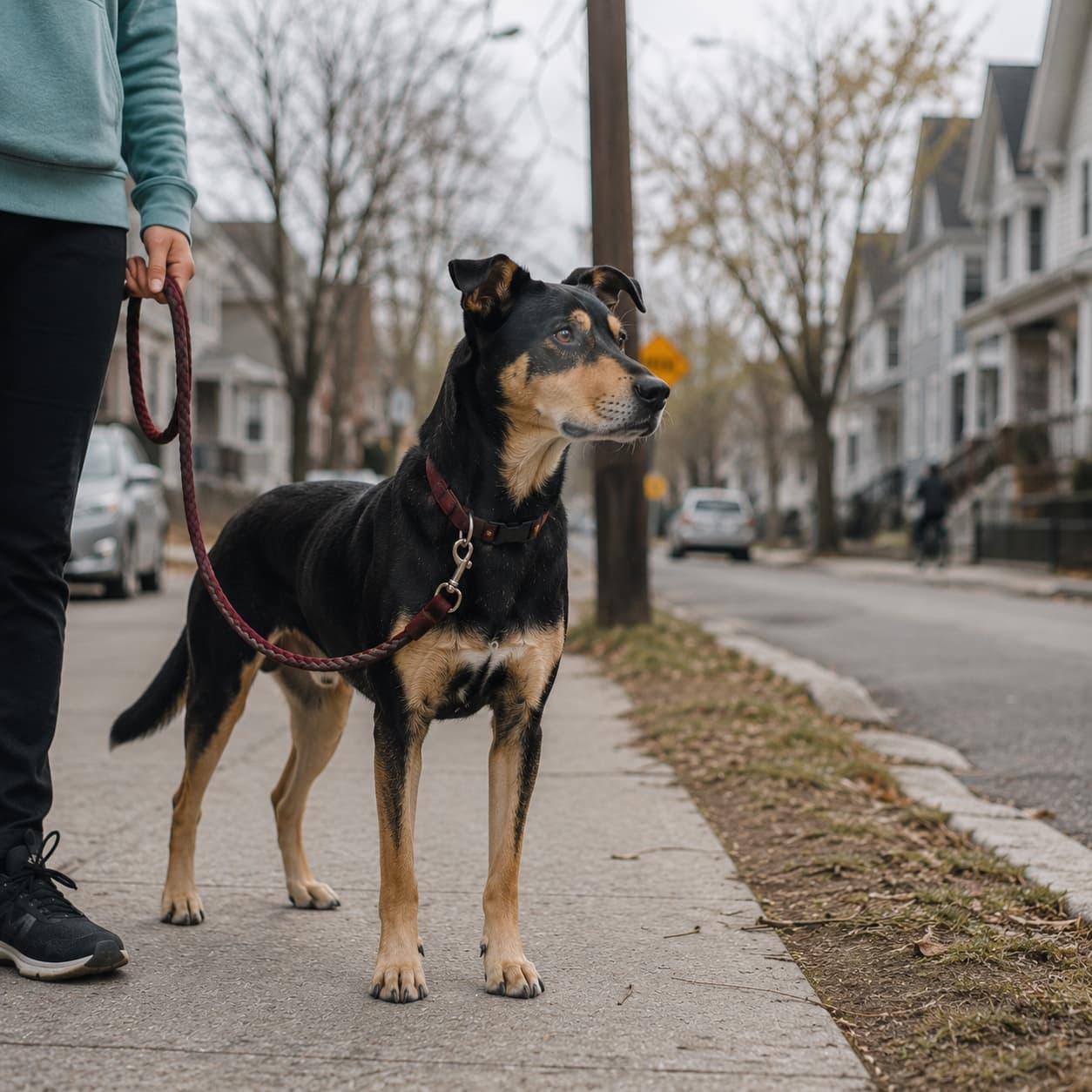
A reactive dog is a dog whose response to a normal trigger is bigger than the moment can safely hold. The trigger might be another dog, a stranger, a bike, a child, a delivery truck, or a narrow sidewalk where the dog feels trapped.
The useful reframe is simple: reactivity is information, not a moral failure. Your dog is telling you the current setup is too hard.
Reactive dog meaning
The simplest reactive dog meaning is this: the dog crosses threshold around a specific trigger and responds with more intensity than they can easily recover from. That response may look like aggression from the outside, but the underlying driver is often fear, frustration, excitement, pain, or a loss of distance options.
This is why dog reactivity should be trained as an emotional and environmental pattern, not just as a manners problem. A leash reactive dog does not need to be forced closer to triggers to learn. They need a setup where noticing the trigger can stay safe enough to practice.
What causes dog reactivity?
Dog reactivity usually has more than one cause. A puppy may start with poor socialization, a rescue dog may carry fear from earlier experiences, and a friendly adolescent may become reactive after months of frustrated on-leash greetings. Pain, sleep, hormones, neighborhood density, and repeated corrections can all lower the dog's threshold.
The practical question is not "what is the one cause?" It is "what pattern keeps showing up?" If your dog reacts only on leash but plays well in open spaces, start with leash restriction and barrier frustration. If reactions get worse after a hard day, look at trigger stacking.
Most reactive dogs are easier to help once you separate the driver from the visible behavior.
| Possible driver | Common clue | First training priority |
|---|---|---|
| Fear or uncertainty | The dog stiffens, freezes, hides, barks to make the trigger leave, or recovers slowly. | Add distance and use counter-conditioning below threshold. |
| Frustration | The dog pulls forward, whines, bounces, or gets worse when greetings are blocked. | Stop on-leash greetings and reward disengagement near dogs. |
| Pain or discomfort | The behavior appears suddenly, escalates quickly, or happens with handling and movement. | Ask your vet to rule out medical causes before increasing training difficulty. |
| Stress stacking | Small triggers create huge reactions after travel, guests, poor sleep, or prior incidents. | Lower exposure and protect recovery for the next 24-72 hours. |
What reactive dog behavior looks like
Reactivity can be loud and obvious, but it can also be quiet. Barking and lunging get attention. Freezing, hard staring, frantic scanning, or refusing food can be just as important.
Watch for the whole pattern, not one isolated behavior.
| Behavior | What it may mean | First response |
|---|---|---|
| Barking or lunging | The dog is already close to or over threshold. | Create distance and make the next setup easier. |
| Freezing or staring | The dog may be processing, worried, or about to escalate. | Mark early, feed, and move before the bark starts. |
| Refusing food | The trigger, environment, or stress level is too intense. | Increase distance and lower trigger difficulty. |
| Slow recovery | The event was harder on the dog than it looked. | Use decompression and track recovery time. |
Reactive does not always mean aggressive
A dog can bark, lunge, or look terrifying because they want distance, because they want access, or because stress has stacked across the day. That is why the next useful article is reactive vs aggressive dog: safety matters, but labels should not replace pattern reading.
Common reactive dog triggers
- Other dogs on leash, especially on narrow sidewalks.
- People approaching directly, staring, reaching, or running.
- Bikes, scooters, skateboards, joggers, and sudden movement.
- Noisy vehicles, delivery trucks, school buses, and construction.
- Home-window, fence, doorway, or car-barrier situations.
What not to do with a reactive dog
The fastest way to make reactivity harder is to put the dog in setups where they keep practicing the same over-threshold response. Repeated barking, lunging, corrections, and forced greetings can teach the dog that triggers predict pressure instead of safety.
Avoid these first
- Do not force greetings to prove your dog is friendly.
- Do not correct barking near the trigger before creating distance.
- Do not train on the hardest route because it feels like real life.
- Do not ignore food refusal, freezing, or slow recovery.
- Do not measure progress only by whether a reaction happened.
What to do first
The first step is not more obedience. It is management. Choose quieter routes, add distance, skip on-leash greetings, and start tracking what happens before and after each reaction. If walks are chaotic, use the 7-day reactive dog training plan to reset the daily loop.
How to tell if the plan is working
A reactive dog training plan is working before the dog looks "cured." Early progress is usually quieter and smaller: the dog can notice a trigger farther away, take food sooner, recover faster, or choose one second of sniffing instead of staring.
If the trend is flat after several weeks of easier setups, compare your expectations with a realistic reactive dog timeline before adding harder exposure.
When a reactive dog needs professional help
Most reactive dogs can improve with humane training, but some cases need hands-on support. Get help sooner if there is bite history, redirected biting, reactions toward children, sudden behavior change, suspected pain, or a dog who cannot recover even after distance and easier walks. For a realistic recovery frame, read can a reactive dog be cured.
Evidence basis
This article is grounded in humane, reward-based behavior guidance and PawZen's science page.
Quick answers
What does reactive dog mean?
A reactive dog has an intense response to a trigger, such as barking, lunging, freezing, spinning, or screaming. The response is bigger than the situation calls for because the dog is over threshold.
Is a reactive dog aggressive?
Not always. Reactivity can come from fear, frustration, excitement, or stress. Aggression is about intent and safety risk, so bite history, redirected biting, or escalating threats deserve professional help.
Can a reactive dog get better?
Yes. Many reactive dogs improve with management, distance, counter-conditioning, recovery, and consistent sub-threshold practice. Progress usually looks like faster recovery and more thinking before it looks like perfect walks.
What should I do first with a reactive dog?
Stop rehearsing hard reactions, choose easier routes, learn your dog threshold distance, and reward calm noticing before the dog tips over. The first job is to make learning possible.
What causes dog reactivity?
Dog reactivity can come from fear, frustration, poor socialization, pain, stress stacking, leash restriction, or repeated bad experiences. Most dogs have a pattern rather than one single cause.
What should I not do with a reactive dog?
Do not force greetings, punish barking near triggers, or train on the hardest route first. Start with distance, easier setups, and recovery so the dog can stay under threshold.
Related reading
- Reactive vs Aggressive Dog: Key DifferencesBarking and lunging can look scary from the outside. But reactivity and aggression are not the same thing, and the difference changes what you do next.
- Fear Reactive vs Frustrated Greeter: Key SignsTwo dogs can bark, lunge, and embarrass you in exactly the same way for opposite reasons. One wants distance. One wants access. Mixing them up is how good owners train the wrong thing.
- Reactive Dog Training Plan for the Next 7 DaysIf walks feel chaotic, don't start with a bigger theory. Start with seven calm days: fewer rehearsed reactions, cleaner distance, short LAT reps, and a simple way to tell whether the plan is working.
- Can a reactive dog be cured? An honest, research-backed answer.Reactivity isn't a defect to eliminate. It's a nervous-system state that can be retrained, managed, and — over time — made almost invisible. Here's what the research actually says.
- Reactive Rescue Dog: What to Expect and How to HelpA reactive rescue dog can absolutely become a calmer family member. The first weeks are about safety, sleep, predictable routines, and distance — not fixing every trigger on day one.
- Reactive Dog in an Apartment or City: A Practical GuideCity life adds predictable triggers: tight hallways, elevators, sudden dogs around corners, and limited escape routes. The plan is distance, timing, and rehearsal control.
Start your free assessment
Get a personalized training plan based on your dog — not a generic protocol.
Optional: notify me when the 30-Day Calm Walk Reset program opens (not required to use the free app).